

What is apraxia?
Childhood apraxia of speech (CAS) is motor speech disorder affecting a child’s ability to coordinate the motor movements of speech. It is often referred to simply as “apraxia”.
Apraxia is a diagnosis familiar to many families at The Carruth Center and The Parish School Our speech-language pathologists are not only experienced in treating this disorder, but have extensive, specialized training.
Nancy Kaufman, a well-known and respected expert in the field of childhood apraxia of speech, has provided training and consultation services to The Parish School and Carruth Center therapists since 2009.
About Nancy Kaufman and Her Impact
Nancy Kaufman is a speech-language pathologist based in Michigan. She has dedicated much of her career to the development and implementation of targeted interventions to bring vocal communication to children with apraxia.
Since 1979, Nancy has worked to create the Kaufman Speech to Language Protocol (K-SLP).
K-SLP is an effective, evidence-based treatment approach consistently utilized by speech-language pathologists worldwide through use of specialized materials and treatment strategies.
Nancy is recognized both nationally and internationally for her work in furthering the treatment of CAS, and remains a leader in the field through her research and seminars.
How the Kaufman Speech to Language Protocol (K-SLP) Works
The K-SLP program incorporates play, picture cards and repetition.
- The goal in treatment is to provide children with a practical path to become an effective verbal communicator.
- Asking a child who struggles to speak to say full words is too demanding; hence, approximations of words are incorporated (see “why do we teach approximations” below), and the motor planning demands on a child decrease.
- Through intervention, the child’s team will work towards perfecting words while increasing his or her expressive language using a list of “favorites”, pivot phrases and words, and functional requests.
- A “favorites” list includes everyday vocabulary a child uses or is exposed to in his or her environment. Incorporating these words into therapy is not only functional, but also highly motivating.
Why Motivation and Play Matter in CAS Therapy
Nancy Kaufman stresses the importance of keeping a child motivated in therapy. This can be accomplished through use of toys and a favorites list.
It is also important to implement errorless teaching (cueing before failure) so that a child can always feel successful.
K-SLP Materials and How To Pair Them With Therapy
Nancy Kaufman developed several materials for children with CAS
K-SLP materials are available to the public and frequently seen in clinics and homes; however, the materials alone do not represent an understanding of the methodology.
Training and feedback are essential to using K-SLP effectively. While the K-SLP materials, specifically the picture cards, are very beneficial to a child, therapy is much more than drilling cards all session.
The goal is to use these visually stimulating cards to target specific syllable shapes, provide a clear model for a child, and allow a significant amount of repetitions each session. The end goal for therapy is to eventually conduct sessions without any cards.
The Role of Parents and Home Practice
K-SLP focuses on the importance of a child practicing new skills through play and in their natural environment. Parents, other family members, and caregivers can orchestrate the environment to offer even more opportunities for practice of new skills and while providing motor speech cues as needed.

What Are Approximations in K-SLP?
The K-SLP focus on moving toward functional speech is heavily reliant upon the use of approximations at first.
An approximation is a simplified version of a target word that uses consonants and vowels already a child’s repertoire to create a “version” of the word that can be understood by others as a child works towards a full-word production.
Approximations are developed based upon the natural speech acquisition pattern. Therapists use a simplified version of the word, but the focus of therapy is to shape the child’s production as close as possible to the target word.
As a child gains new sounds and syllable shapes, his or her earlier approximations transition to include the most complex, attainable form at that time.
Think of approximations as the training wheels that will eventually be removed when a child has practiced to the point of consistency in their two-wheeling abilities.
Nancy’s Work with The Parish School
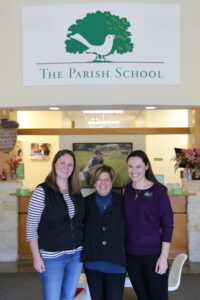 Since 2009, Nancy Kaufman has provided training and consultation services to The Parish School and its on-site therapists from The Carruth Center.
The Parish School is an early intervention special needs school located in Houston, TX. It is home to The Carruth Center, a pediatric therapy and assessment destination for families of children with learning delays or disorders.
During her annual trips to The Parish School, Nancy:
- Works directly with clinicians and their clients to provide feedback on best practice strategies for each client.
- Helps train speech-language pathologists in her methods to allow for the most efficacious treatment.
- Gives an annual seminar or families, detailing the treatment of CAS through specific client examples.
Anyone who has attended one of her presentations can attest to the fact that Nancy brings that same enthusiasm to the education of parents and therapists that she brings to each therapy session.
Speech-language pathologists at The Carruth Center and The Parish School implement the Kaufman Speech to Language Protocol (K-SLP) in their treatment for children with childhood apraxia of speech, speech sound disorders, or those who have difficulty with expressive language.
We are thankful for Nancy Kaufman’s support and contributions to Carruth and Parish staff and in turn, families. We proudly offer K-SLP based services and look forward to using our skills to support your children’s needs.
References:
- http://www.kidspeech.com/
- https://www.apraxia-kids.org/library/the-successive-approximation-method-of-therapy-for-children-with-apraxia-of-speech/
—
Taylor Kopycinski, MS, CCC-SLP, is a speech-language pathologist at The Carruth Center with clinical experience in childhood apraxia of speech, oral motor and articulation disorders, and language development. She is passionate about creating motivating and supportive therapy environments for children and families.


